BOLD DESIGNER, FREEFORM AND TRADITIONAL CABOCHONS FOR JEWELRY ARTISTS AND COLLECTORS

Wednesday, January 5, 2011

Workshop Completed!!

OK..... I haven't been TOTALLY consumed with setting up a new workshop since my last post at the end of November...... there has been the holidays going on, family friends and so forth, along with my 'day job' etc.... etc........ but............ the project of setting up a larger workshop is now complete!  I installed a new vinyl laminate water proof floor, water supply and drain lines, electrical circuits, new benches and cabinets and brought in my small trim saw from the shed and put it in the workshop too.
In one corner, along one leg of an 'L' I have my two variable speed Covington units with 8x3 rubber wheels and diamond sanding belts.  The corner cabinet and end cabinet give me lots of room to stash stuff and things.  You can also see the drainage system of 1 12" ABS pipe with the poly tube drain lines from the equipment fed into the pipes.  You can also see I am big on wall mounted task lights that can be positioned close the work and easily moved out of the way too.
On the wall, I have run surface mounted electric circuits for the equipment and a water supply line with shut offs for each water feed to each individual sanding/polishing wheel.  Additionally each wheel has a needle valve to precisely control the water flow to the wheel.
Along the other leg of the 'L' you can see my 8" flat lap on the right, and a rack of laps in the corner, a 6 wheel Diamond Pacific 'Pixie', which I use primarily for sanding and polishing opals, in the middle, and on the left end is a 'Rock Rascal' 6" trim saw.  Another handy narrow base cabinet supports this end of the 'L'.  There is never a shortage of stuff needing a place to live.  Since this picture was taken a new small two wheel buffer has taken up residence on the end of the bench for final polishing of opals only. (I don't buff regular  cabochons - I polish up to 100,000 diamond mesh on the Covingtons)
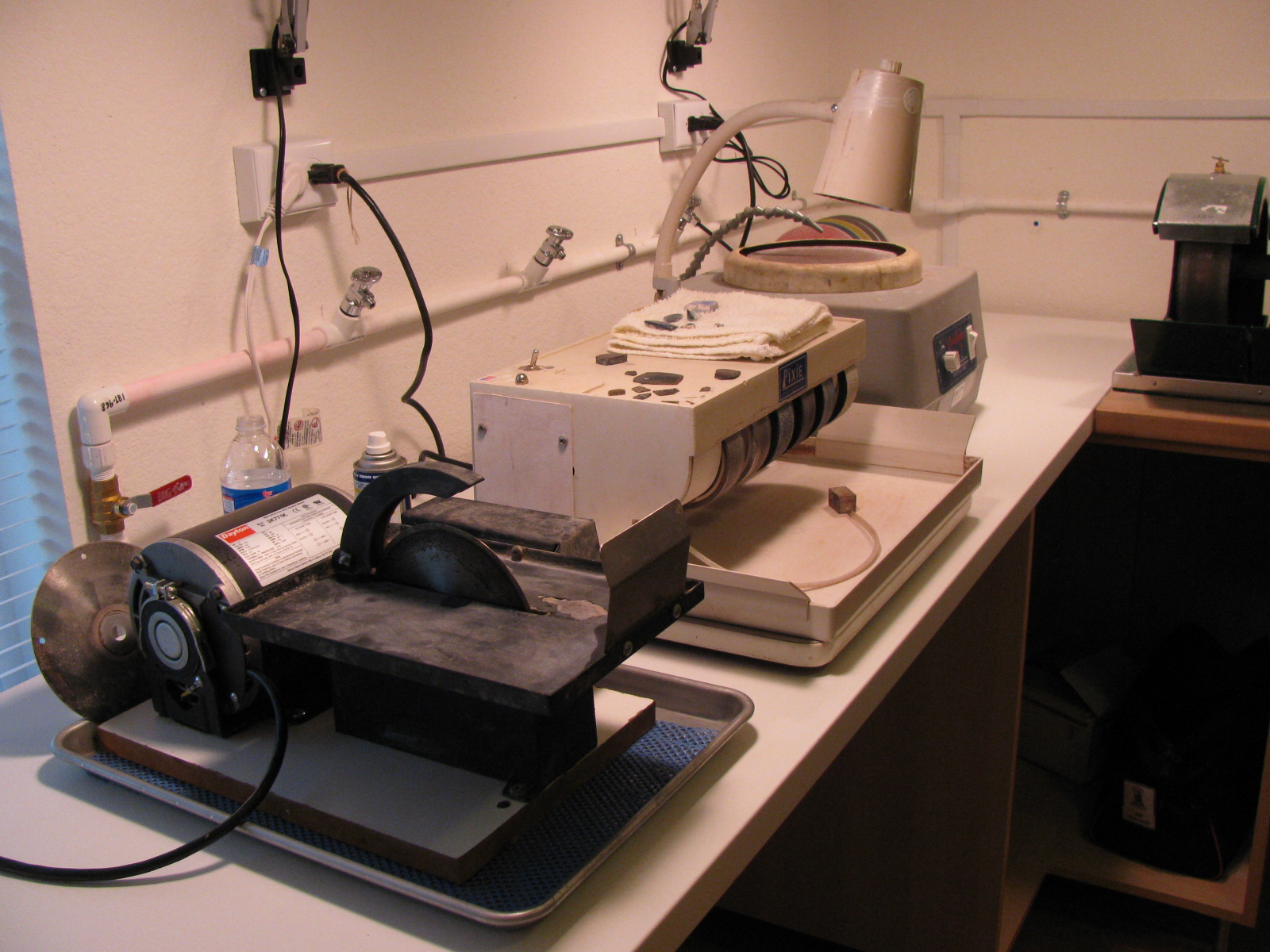
To keep everything neat and clean, the trim saw, mounted on a piece of MDF board, is sitting in commercial restaurant 1/2 sheet pan.  Under the saw and under the pan is a piece of mesh rubber tool drawer liner which keeps it all in place with no slipping.  In this picture you can also see the main shut off ball valve on the water line.
Opposite the 'L' with the power equipment is my work bench where I layout my template lines on slabs, dop the stones either using wax and wooden dowels, the old fashioned way, or more commonly, glue up the saw trimmed preforms onto machine screws for use with my aluminum dop sticks. (See related post)
This is also where I measure, weigh, label, bag and record the information on each cab for my inventory.
Adjacent to the work bench is a closet and next to that is a bookcase.  You can see a large double stack machinist's tool chest, full of useful things I need in the shop.  You can also see egg crates on one of the shelves which hold partially finished pieces and saw trimmed preforms I intend to work on.  The bottom two rows of the book shelf hold plastic shoe boxes full of slabs.

By the way..... I was raised as a tool & die maker in the family injection mold making business..... so, no - I didn't clean up the shop for the photos.  I always keep it clean.  really!

I hope you enjoyed the tour.

Tuesday, November 30, 2010

AMMOLITE

I recently was given a wonderful gift of some spectacular Ammolite rough.  Here are a few pieces that I have started to process.  Each is about the size of a quarter.


Ammolite is a very rare opal-like gemstone found primarily in Alberta, Canada.  It may well be the rarest gemstone on earth, as rare as genuine red diamonds.

Ammolite is the fossilized shells of Ammonites, which are composed of aragonite, the same material as pearls.

Ammonites were spiral disc shaped cephalopods that once lived in tropical inland seas, becoming extinct along with the dinosaurs about 65 million years ago at the end of the Mesozoic era.

The iridescent opal-like color play of Ammolite is caused by the interference with the light which rebounds from the very thin stacked layers of aragonite platelets.  Reds and green are most common, but all colors of the spectrum are possible.  Thicker layers of platelets produce the reds and greens, thinner layers of platelets the blues and violet at the other end of the visible spectrum.

The Ammolite layer is a very thin sheet, often not more than 0.5mm thick and is usually backed with its dark gray to brown shale matrix.

Because Ammolite is relatively soft for a gemstone (4.5-5.5 on the Mohs scale) and the very thin mica-like platelet layers are subject to flaking, it is common for Ammolite to be treated with epoxy or polyester resin to harden and stabilize the material prior to cutting and polishing and to be made into doublets and triplets with a clear quartz cap to protect the delicate Ammolite from damage.

Look for reverse doublets and triplets of this spectacular gemstone in my on-line store soon.

Thursday, November 4, 2010

Lightning Ridge black opals

The second week of classes I took at William Holland School was OPALS taught by Joe DePietro.  The class was first rate as Joe is a veteran opal cutter and long time dealer with a wealth of knowledge and experience.  I had purchased a small parcel of Lightning Ridge black opal rough at the Denver show this year, in anticipation of taking this week of instruction.  Apparently I had some beginners luck in choosing a good lot, since I was able to find some good color and I cut a few nice stones.  Joe was kind enough to evaluate them using a software program called 'Smart Chart' available through opalmine.com.  It is a 14 step process of evaluating type, brightness, body tone, shape, color, coverage, weight and many other factors to arrive at a 'field wholesale' price from a database periodically updated through the website based on market activity and market conditions.  I was stunned at the prices, nearly as much as I was amazed and captivated by how spectacular Lightening Ridge black opal can be.  Last year at the Tucson shows I talked a good deal to various opal dealers and cutters who all told me - once you start cutting opals, it will capture you and regular cabochons will never be the same anymore.......... I see their point........
1.25 ct. N3 green-blue, slightly-bright oval


4.45 ct. N4 green, blue,orange bright freeform

I also cut a couple of nice blue stones that were evaluated using Paul Downings method and brightness scale with comparables drawn from his newsletter market updates

9.65 ct.

8.00 ct.

I have several other nice stones in progress and have converted several chucks of rough to 'rubs' in search of color.  I have several more some nice pieces of the deep cobalt blue with N1 body color and some lavender color crystal with a moss pattern.

Stay tuned for more pictures and updates on opals.

By the way.  If you are interested in purchasing any of these stones, they are available.  Money back guarantee if not satisfied.  E-mail me at cabochondesignz@gmail.com

Sunday, October 24, 2010

William Holland 3

Thursday night after supper there is a "tailgate" show in the dining room where students and instructors can sell their creations.  It only lasts and hour, but I sold 9 cabochons that evening.  The day before I sold a nice flat top ruby zoisite stone to a student in the Silver I class........


.........and two nice rutilated quartz cabs to a fellow student in my Cabochon class.  She had both of them wire wrapped by the Wire instructor, Dawn Thornton of Dawn's Creations in Welaka, FL.  Dawn's web-site is: dawn-n-mack.com


Wednesday, October 20, 2010

Wm. Holland School 2

Tuesday night there is an auction of donated items to help pay the costs of equipment and supplies at the school.  Not all items are lapidary or jewelry related, but most are.  It's for a good cause and some of the items are bid up well beyond all expectations...... how 'bout a chocolate bar for $10.  The best item in the auction was a gorgeous slab of old stock blue Biggs Jasper that was phenomenal.  I think it went for $60

The auctioneers are well known to the regulars and do a great job getting the bids from the crowd.  Everybody's favorite is the Opals instructor Joe DePietro, who has very poor hearing..... you'll say $5 and he'll recognize the bid as $7.... ask for $10....recognize a phantom bidder in the back of the room at $10...return to the previous bidder.....'what?  whad chu say?? (silence) $12??... you said $12....I have $12..... who'll give $15??       I not really sure how deaf old Joe really is.......   What a riot.... It was a hoot.
Joe Depietro

Wednesday afternoon is free time.  I drove through the mountains to Franklin, NC., visited the gem and mineral museum, drove some nice narrow curvy roads and returned to Young Harris after dark.  Great day.

Tuesday, October 19, 2010

Wm. Holland School of Lapidary Arts

Today was the second day of classes.  Excellent instruction, good facilities, beautiful North Georgia mountains, fall foliage, perfect weather.  What a deal!!

Cabochon Classrom and classmates

Six 'Genies' and all the extras needed..... trim saws, dop pots, buffers, etc.  It is really nice to meet new people and chat with folks who have the same interests you do.
 Past Otto's Lodge, up the hill in the trees, is Spark's lodge

Otto's Lodge is essentially a motel for students.  Wow!  better than name brand motels I stayed in on my cross country road trip to get here.  Sparks Lodge, also has rooms for students as well as the dining hall and most of the classrooms.


Saturday, October 16, 2010

"Mystery Agate"

OK - does anybody know what this stone is --  or might hazard a guess?


This is not a trick question.  I don't know what it is.  I got the small slab remnant from the scrap bin at the Old Peublo Lapidary Club cabbing lab about two years ago.  I don't have it listed for sale on my Etsy on-line shop, because I don't know what it is.

I think it the pattern on it looks like a tornado.  Hey - what can I tell you - I used to see all kinds of things in the clouds  as a kid while lying on my back in the cool grass down by Sackett Brook........


Friday, October 15, 2010

TEXAS!

Note to my Lone Star friends:  I like country music.... really I do..... but contrary to popular Texas belief, as judged by the number of country stations on the radio dial, ....... THERE ARE OTHER KINDS OF MUSIC Y'ALL!!!  (I get to say -y'all- because I lived in North Carolina for the biggest part of my adult life).  Now that I got that of my chest - I am at the end of my second day on the road and doing my duty as a guest of this BIG country - watching the Texas Rangers beating up on the Yankees!!

I have stopped at a couple of rock shops and bead stores along the way from AZ, through NM and TX.  It is always fun to chat with store keepers and I always see a few cabs I am envious of.

I waved when I was going through Fort Worth and passed the road that takes you toward Trophy Club......

On to Louisiana, Mississippi, Alabama, and Georgia...... the weather has been perfect.

Wednesday, October 13, 2010

Road Trip!!

In the morning I am hitting the road.....heading for northeast Georgia for two weeks of classes at the William Holland School.  Week one - Cabochons.  Week two - Opal cutting.  The weather should be cool and maybe I will get to see some fall color in the Appalachian Mountains while I am there.  I hope there is some left by the time I get there.  I wish I had lots of time to travel the Blue Highways, but this is going to be a green sign, I-something-or-other, what state am I in now, trip.

I have plenty of slabs and a bag of Lightning Ridge black opal rough to work on........ I can't wait!!!!

Saturday, October 9, 2010

Turquoise Hunt

Yesterday I went to Bisbee, AZ for the annual turquoise hunt sponsored by the Bisbee Mining & Historical Museum.  Once each year the museum has access to the mine dumps from the famous copper mining operations in Bisbee.  Organized and coordinated in conjunction with Freeport McMoran Copper, the current mine owner, rockhounders who purchase tickets for this event are transported by bus from a lot across the street from the museum past the original Sacramento pit and the famous Lavender pit, onto and through the mine property to dump #7 where the mining company generously 'rips' (turns over) the tailings on a broad flat area known to yield some nice turqouise, including some of the brilliant deep blue 'Bisbee Blue'.  The company provides drinking water, water for washing your finds, port-o-john facilities, stand by first-aid capability just in case, and a few polite mining company employees to remind us when we have wandered past the designated collecting area or onto the steep slopes and berms, which is verboten, for good reason.

I did not have much luck, but a few nice pieces were found by others, as always, which keeps us eternally hopeful and coming back again.  I was looking for material that would produce at least a 10 x 8 finished cab, and although I found many nice chips with great color, I left them behind hopefully to be found by one of the many first time novice rockhounders or children whose day would be absolutely made by finding even a small piece of 'Bisbee Blue'.  I suspect that there are many small treasures being proudly shown to family and friends today.

Despite not finding a monster chunk of some of the rarest and most beautiful turquoise in the world, it was an awesome day.  Great Arizona fall weather - clear blue cloudless sky, mid to high 80's - good conversation with old and new friends, giving a little advice to eager novices, getting a bit of sage advice from the old timers who really know their stuff.  There is not a better way to spend a day.